Wednesday, March 27, 2013

Boats of San Diego


Boats abound in San Diego, home to the Pacific Fleet, the USS Midway, an excellent Maritime Museum as well as all varieties of recreational boats.  I’ll begin with the USS Midway and a bunch of factoids that we found interesting, then move on to the Pacific Fleet and finally the Maritime Museum.

USS Midway decommissioned and now a museum in SD harbor.


USS Midway

The USS Midway was commissioned in 1945 and accrued an impressive history during her time.  She was decommissioned in 1992 and opened as a museum in 2004 with more than a million visitors each year.  Not often does one get to go on an aircraft carrier so we figured we’d spend an hour or 2.  They kicked us off at closing time many hours later.  I know you’re all dying to hear all about her.  This is one hell-of-a boat or more correctly ship, only submarines are called boats.  She's 1001 feet long, 258 feet at the beam and has a 4 acre flight deck.  OK all you boat owners, tab up those dockage fees.  Don’t want to pay dockage just drop a couple of 20-ton anchors, who’s going to tell you different?  I don’t think I could lift one link of the chain. Packed in are a crew of 4,500 including 5 physicians and 3 dentists.  Feeding this hoard requires 225 cooks who delicately prepare 10 tons of food each day.  But does that include the grog?  And, for the motor-heads out there: under the hood she’s got 12 boilers that generate 212,000 horse power.  Oh but the fuel economy: 260 gallons per mile or 100,000 gallons a day.  Let’s just hop on over to the south Pacific.  “Fill her up sir?”  Why sure, that’ll be 3.4 million gallons.  Since that’s only a month's supply send on tankers to follow us.  This tour was awesome with many an eye opener.  We’ve seen at least 3 other active carriers in port.  The USS Reagan slipped in last week when we weren’t looking.  The new ones have "solved" the fuel economy with a pair of nuclear reactors each.

Midway's flight deck included samples of many aircraft used throughout it's long history. 


Pacific Fleet


Along the row of piers that are home to the Pacific Fleet.


Lot's of tankers and frigates but a few really caught our eye.  This is a quite large pursuit boat of some sort.
And, a smaller one apparently capable of 60 mph.
Assorted frigates and other ships of the Pacific Fleet with the Coronado bridge & San Diego in background.
We witnessed several sub arrivals & departures.  This one from Point Loma.
This sculpture honors many a welcome home or departure to an uncharted future for sailors of the Pacific Fleet.

The Maritime Museum


I wasn’t big on it but Nancy insisted (because she wanted to see the HMS Surprise) on visiting the Maritime Museum along the embarcadero.  Score one for Nancy: what we thought would only take an hour or 2 took most of an enjoyable day.  The museum included a number of ships & boats to explore, each containing models and a plethora of well presented historical information.

Star of India (1863) 212-feet long, 280 feet with spar.
She was launched in November 1863 in England I presume and is the world's oldest active merchant ship.   Her first voyages took her to India for cotton, unavailable from the US due to the Civil War.   She soon turned to transporting emigrants from England to New Zealand.  Other stories followed and she is one of the few remaining ships from the "Age of Sail".   Meandering above and below decks provided some feeling of what life aboard was about.  Very spartan when compared to todays vessels but almost luxurious when compared to the HMS Surprise that I'll get to next.

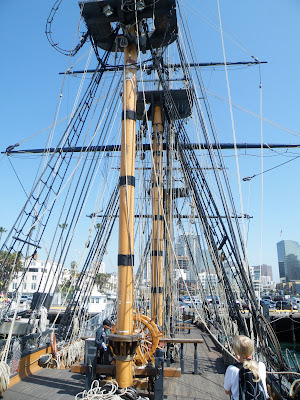
HMS Surprise (replica of 1700's British frigate), 179-feet overall. 

She spent the first 30 years as a training tall ship on the east coast.  She was later purchased by 20th Century Fox, modified, and became the HMS Surprise for the movie "Master and Commander".  Moving above & below decks it's just about impossible to imagine the hardships faced by these sailors as they traveled to the far reaches of the oceans.  Cramming well over 100 men, necessary for manning and fighting, into a ship of this size would be hardship enough.  Throw in stretches of doldrums, typhoons, freezing cold, scorching heat, short rations, and all to find other lunatics so that you could fire canon balls at each other at point-blank range.  None of this apparently bothered them more than running short of grog, now mates we have a problem.

"OK Nance,  prepare for sail"

"Yeah, I'll get right on that"


Here lies the Captain's cabin, the only space that might be called spacious.  Captain's of this era were more like gods or at least kings aboard their ship.  Can't you Patrick O'Brian fans just vision Aubrey & Maturin sawing away on their violin & cello behind these ports.

Next came a Soviet submarine.  B-39 is a diesel-electric Soviet attack submarine.  Clancy readers will recognize this as a "Foxtrot" class from many of his novels.  During the Cold War this one may have actually stalked several of the Pacific Fleets nuclear subs, that today share SD harbor.  This boat is just shy of 300 feet and held a crew of 78.  I knew that submarine life was cramped but going below made it seem unbelievable.  Not for me, fortunately.  Modern nuclear subs are probably less cramped & spartan as I don't think the Soviets were known for their creature comforts.

Soviet (1974) Foxtrot class attack sub of the Cold War era.

Soviet sub

Another sub, the 165-foot USS Dolphin, was used primarily as a research vessel.  In 1968, the year she was launched, she set an operating submarine record depth that still holds today.  It's still "classified" but her listed operating depth is 3000+ feet.  She was decommissioned in 2007 and claims many other "firsts" in her legacy.

We took more photos of other ships but they have somehow disappeared into the digital atmosphere.  I'm tiring of this page myself anyway so I'll sum it up.  There were a couple of "America's Cup" sailboats and a beautiful old steam/sail "hunting yacht".  Apparently in 1904 it was easier or at least one could with greater luxury move about Scotland's hunting spots using a 134-foot yacht than by land.  There was also a grand 279-foot steam ferry boat built in 1898.  With her Victorian elegance, the Berkeley was the first steel hulled, double-ended ferryboat to ply San Francisco Bay.  One event of note was when she helped evacuate a burning San Francisco following the 1906 earthquake.  Today she houses loads of historical displays, naval, tuna fishing, commercial...


Sunday, March 3, 2013

San Diego: Chula Vista Digs

San Diego: Chula Vista digs

Our first sunrise in Chula Vista, looking across the neighboring marina from rv park.


Compared to boon-docking in Borrego Springs, where we had no services, the Chula Vista RV Park is luxurious.  We have electricity, pressure water, showers, pool, hot tub, small gym, even cable TV, something we don’t have at home.  Not necessarily better but very very different.  Since it looks like we’ll be in San Diego for a while and there’s so much to do I’ll try to post a few different pages before it gets overwhelming and I just forget about it.

The trolley is a 12 minute walk and provides access to all of San Diego.  We’ve been here about a month and have been to an IMAX movie and toured several museums including the Air & Space, San Diego Art, Model Railroad and Timken Art, all of which and more are in Balboa Park. We’ve biked or more often walked the Embarcadero, Little Italy, Gaslight District, as well as a couple of beach walks.  We've been to Tijuana, toured the USS Midway, sailed out into the ocean, checked out Coronado, Mission Beach, and the La Jolla area.  I'll post these on separate pages, stay tuned.

Chula Vista RV park as we sail by on our way out into San Diego Bay & beyond.


Our location as viewed across entry channel to marina.  The Coronado bridge and downtown San Diego in background. 
View north to SD from beach adjacent to our location.
View south from same spot. These photos are all of San Diego Bay.

Sly devils, these egrets are quite the fisherbirds.  They go into the shallows and wiggle their toes, simulating worms, to lure in a tasty fish dinner.
Bird of Paradise plants are ubiquitous around the rv park and elsewhere.
Scoots seem to graze in the morning but spend most of their time in the water.
Shore birds are also plentiful, a welcome change from the desert.

Mallards, Scoots, and my favorite, probably because we don't have any home, the Pelican.

Monday, February 4, 2013

"Pegleg" Campsite at Borrego Springs


Borrego Springs, CA 12/8/12 to 1/28/13


Pegleg campsite, facing west.


Returning to “Pegleg”, our old haunt in the southern Californian desert, is as close to “comin home” as any place that’s not Vermont.  Our Canadian friends Ted and Carroll & pooch Suzie were instantly out to greet us as we swung the tin can into a nice spot flanked by them and Mike “The Mechanic” where we spent the next 7+ weeks.  We’ve known these folks and others here for years now.  Bert & Janie arrived in Borrego later as planned with Adam & Sue, fellow Airstreamers who split their time between Maine & Boston when not out on the road.  We all had a hoot together.  Chuck & Ann from Michigan Jim & Jane from Ontario, Dick from Saskatchewan, appeared again, and newcomers Jim & Kendra from Port Townsend, Washington joined the gang around the campfire. 

Pegleg, facing east from first rise on Coyote
Mtn.  We're in lower right corner.
Nearby Borrego Springs is a small quiet town surrounded by Anza Borrego State Park, the largest contiguous state park in the continental US.  Camping out in Pegleg is free but requires a certain degree of independence, as there are no services.  We have all the solar power we need and several water jugs to replenish our tanks so we are self-sufficient and quite comfortable.  Borrego Springs is one of the first communities to be designated “dark sky” so stargazing is awesome.  The weather here is just about perfect.  There were only 2 very welcome rainy days during our stay.  Dan, a friend of Nancy’s from Vermont, came to visit us 2 years ago and hasn’t left.  He’s a true veteran now having made it thru 2 summers.

Happy hour campfires, beautiful quiet starry nights, evening card games, sunny days filled with hiking, biking, horseshoes, an almost acceptable substitute for bocce, and loafing passes time quickly.  Throw in a couple of side trips to LA and Phoenix for medical appointments and suddenly our 7 weeks here are gone.  We are somewhat saddened to leave but it is time to move on to someplace new.  San Diego, here we come.

Nancy abandoned happy hour to bag this sunset for the record.

Taken on morning hike on slope of Coyote Mtn.  Orange groves & nursery just outside town.

Ted on same hike, he's built at least 50 of these "inukshuks"
Nancy hiking a slot canyon.
View from just around the bend from Pegleg on a chilly morning.  

Impressive metal sculptures, including prehistoric animals, raptors, horses, missionaries, 130 in all,  are found all over the Borrego Valley.  Sculptor is Ricardo Breceda.
This Serpent is the largest and most impressive with the last loop of it's tail on the other side of the road.
This scorpion awaiting his final resting place, with people & metal grape vine workers gives a sense of scale.  He is small compared to the Serpent. 
One of the grape vine workers in the background of the Scorpion shot.


Nature's sculpture: "Eagle Rock" 
120 foot long rock Rattlesnake just above Pegleg.  Had a closeup of head but seems to have disappeared.  That'll happen.
Petroglyph found on secluded "Indian Hill" hike guided by Chuck
Century Plant, Indian Hill hike
Adam & Don riding in Coyote Canyon, Bert zooming ahead as usual to get photos.
Nancy & Mike on their last set of horseshoes

Nancy ends her horseshoe season at Pegleg with a Ringer
We haven't seen a Tarantula here before, but caught this guy heading across the desert. 
Bert contemplates last year's hike up Coyote Mtn, as seen from Rattlesnake Ridge.  Pegleg camp is at the left foot of Coyote Mtn. 
Borrego Sheep, the Park's icon.  We surprised, or maybe the other way around, a group of bachelors on a back country hike last year. 
Newly borns handle the rocky slopes quite handily.
Many of ewes are radio-collared for tracking.   
Howls of the ubiquitous coyote are often heard at night.  Cats and small dogs beware. 
Who's that staring at us from just beyond the campfire glow?
Just a little Kit Fox.  No wonder we've seen so few Kangaroo Rats this year.